
THE MEANINGS OF GLASS
For thousands of years, glass has been part of everyday human life, combining function and beauty in a truly unique material. Born from the meeting of sand, fire and human ingenuity, it fascinates with its transparency, its versatility and its ability to adapt to the most diverse contexts: from art to science, from architecture to the table. In this text we explore its main characteristics to better understand its value, its strength and the essential role it continues to play in the modern world.
Here are the most common meanings of the terms used to describe glass finishes and treatments:
THROUGH-COLOURED GLASS
The "mass" is the molten glass during the glassblowing process.
The colour (usually metal oxides) is added to the molten glass, so the glass is coloured all the way through, not painted on the surface.
BOROSILICATE GLASS
Made from a blend of boron and silica, it is stronger, lighter, more resistant to thermal shock, clearer and more expensive, and it can show blue reflections instead of the usual green tint. This type of glass is the strength of some of the most renowned brands, such as Ichendorf Milano, Zafferano and Italesse.
APPLIED SPIRAL TECHNIQUE
While the glass is still soft, a spiral thread is applied to the glass and then repeatedly broken up, creating slanted vertical stripes.
INCALMO TECHNIQUE
Two pieces are joined together to create different colours in a single piece.
It requires great mastery, because both pieces must have the same diameter, thickness and temperature when they are joined.
MOUTH-BLOWN TECHNIQUE
A traditional technique in which the artisan blows through a long iron blowpipe to create an air bubble inside a mass of molten glass. The artisan gathers the molten, compact glass at one end of the pipe and, with their mouth at the opposite end, blows air into the glass to form a bubble. By rotating and moving the pipe, they shape the piece to create, for example, carafes.
LAMPWORKING TECHNIQUE
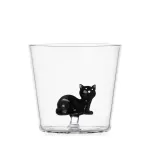
A refined and precise technique in which glass rods, known as canes, are worked directly in the flame of a burner. They are heated until malleable and then used to build a figure, a bead or other decorative elements. It allows great precision in the details and the blending of several colours. It is often used by Ichendorf for its tumbler collections animal farm, desert plants, tabby cat, dogs and many more.
RESONANT GLASS
The resonant glass typical of some Zafferano products is a glassy material with outstanding acoustic quality: when touched or set vibrating, it produces a clear, bright and lingering sound. This property comes from its chemical composition, typically containing at least 10% lead oxide, zinc, barium or potassium.
Resonant glass tumblers and goblets produce a distinctive sound when lightly touched or clinked together: a clear, bright ring that conveys refinement and craftsmanship. This sound is still regarded as a sign of superior quality.
SODA-LIME GLASS
Soda-lime glass is the most common type of glass used in the world. You will find it in most everyday glass items, such as drinking glasses and bottles, windows and glazing, jars and food containers.
Soda-lime glass is transparent, inexpensive to produce and easy to work, qualities that make it ideal for a wide range of everyday uses. While it offers fair resistance to scratches and moderate impacts, it has poor tolerance to thermal shock: when exposed to rapid changes between very different temperatures, it can crack easily.


