
Insights
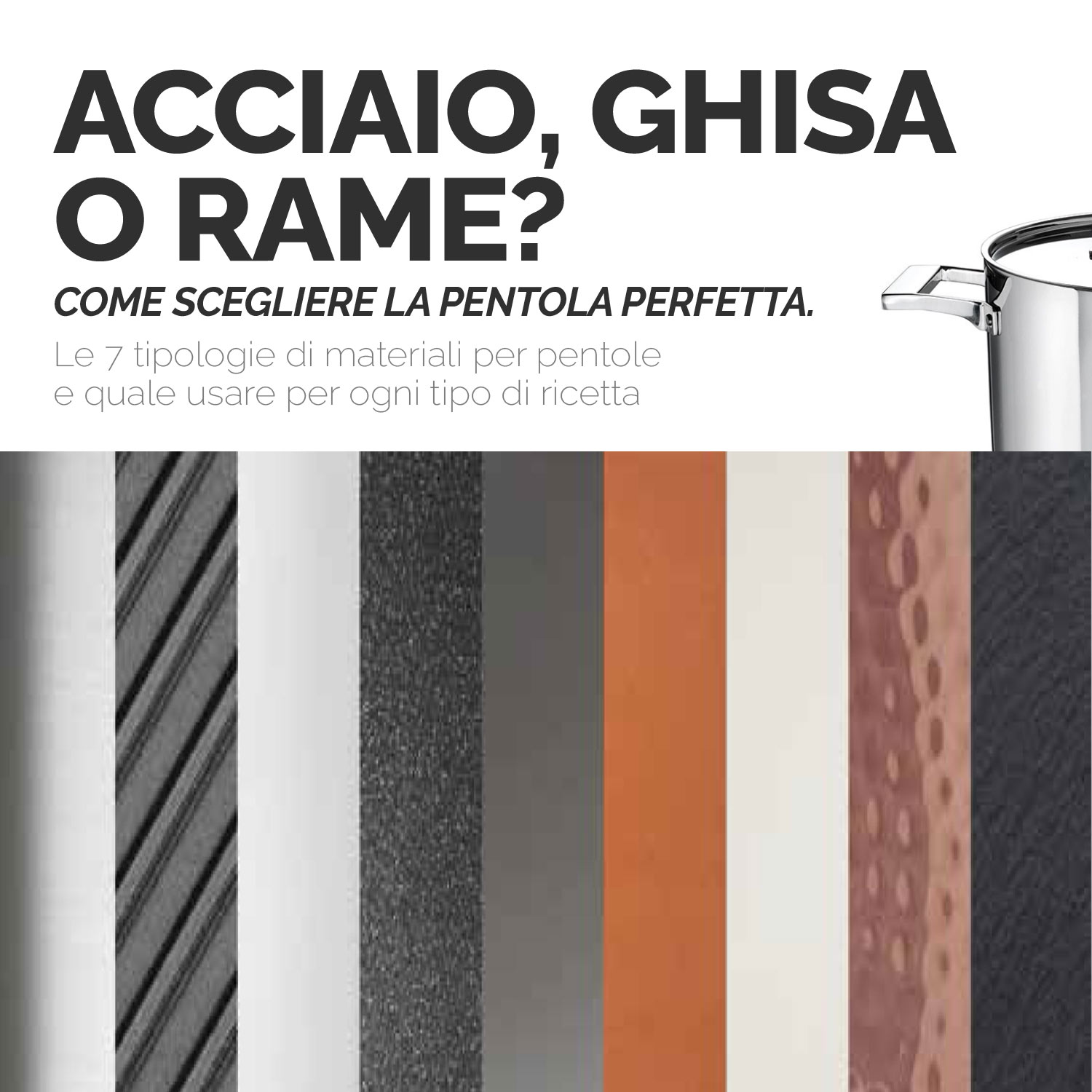
Steel, cast iron, or copper? How to choose the perfect pot.
Materials & Cooking – Buyer’s Guide
Every material reflects a different cooking philosophy. There is no single “best” material—only the one best suited to your cooking style, your heat source, and the dish you have in mind. A guide to help you navigate physical properties, ideal uses, and long-term care.
What You’ll Find in This Article
Buying a pot should be simple. It isn’t. Standing in front of the shelves at a specialty store—or scrolling through an online catalog—you find yourself choosing between materials, finishes, and constructions that promise different results, often with marketing that obscures rather than clarifies.
The truth is that every material obeys specific physical laws: it conducts heat differently, reacts differently to temperature changes, and interacts differently with food. Stainless steel is nearly indestructible but transfers heat slowly—and this isn’t a flaw; it’s simply its nature. Cast iron builds up and retains heat with a consistency that no other material matches, provided you accept its weight and cooking times. Iron improves with every use, developing a natural patina that becomes its signature over the years. Aluminum—whether pure or non-stick—is responsive, lightweight, and economical, but it has its limitations with acidic preparations. Trimetal was created precisely to resolve the contradictions of the others: three layers that combine strengths and eliminate flaws. Finally, copper is the material of absolute precision—loved by pastry chefs because it responds to heat almost in real time.
In the following sections, each material is analyzed according to four objective parameters—conductivity, durability, ease of care, and price—and explored in depth with practical usage guidelines and maintenance tips. The goal is not to declare a winner, but to provide the tools to make an informed choice based on your cooking style, the type of heat source, and the dish you have in mind.
Stainless Steel
18/10 Stainless Steel
The classic that never disappoints. Shiny, hygienic, virtually timeless. It doesn’t absorb odors or flavors—yesterday’s broth won’t contaminate tomorrow’s risotto. Its weakness is heat conductivity: it transfers heat slowly, but when the heat comes from a liquid (pasta, broths, boiled meats), the problem disappears.
In the kitchen
Where it really shines is with liquids: the conductivity is balanced by water or broth, which distributes the heat evenly. It can go directly from the stove to the oven without any issues.
Care and Maintenance
Dishwasher safe without reservation. Warm water and mild detergent for daily cleaning. It withstands impacts and oxidation—if purchased from a reputable source, it will last a lifetime.
Cast iron
Cast iron
Thermal memory made of material. Cast iron doesn’t cook fast—it cooks well. It absorbs heat slowly, then retains it and distributes it across the entire surface with a consistency that no other material can match. It seals meats perfectly: a crust forms, and the juices stay inside.
In the kitchen
Ideal for slow cooking over medium-low heat. Excellent on all cooktops, including the oven. The enameled version adds aesthetic versatility and simplifies cleaning without compromising performance.
Care and Maintenance
Hand wash immediately after use, dry quickly to prevent rust. Enameled cast iron is dishwasher-safe, but be careful of impacts: the enamel won’t forgive.
Iron
Carbon steel
A material that improves with time. Every frying session, every steak leaves a thin layer of natural patina that progressively enhances the non-stick surface. Adjust the heat without sudden changes—the oil never reaches its smoke point if the flame is managed correctly. An investment that matures.
In the kitchen
Before first use, seasoning is required: a treatment with high-smoke-point oil that protects the metal and initiates the formation of a patina. From that point on, it improves with every use. Excellent for the Maillard reaction and deep frying.
Care and Maintenance
No dishwashers, no harsh detergents. After use, use coarse salt and a sturdy cloth. If you’ve cleaned it thoroughly with water, wipe it down with a little oil to protect the surface.
Pure aluminum
99% — stamped, forged, or die-cast
Lightweight like few others, responsive like no other material in the same price range. It distributes heat evenly across the entire surface, eliminating hot spots that burn food. The manufacturing process matters: a die-cast piece offers significantly superior performance to a cold-stamped one.
In the kitchen
Works on everything, saves energy, and is easy to handle. One major drawback: it reacts with acidic foods (tomatoes, spinach, wine), altering their flavor and color. Not suitable for long-term food storage. With a magnetic disc on the bottom, it also works on induction cooktops.
Care and Maintenance
Not dishwasher-safe—aggressive detergents dull and damage the metal. A dark patina may form with use: this is normal, does not affect performance, and should not be removed.
Non-stick aluminum
With PTFE or ceramic coating
The base is aluminum — same conductivity, same weight. The difference is the coating: a layer that allows you to cook with very little or no fat. A real convenience, but fragile. The quality of the coating varies greatly between products: in this case, price is a reliable indicator of longevity.
In the kitchen
Perfect for delicate cooking where the ingredients must not stick or be overcooked. The coating is sensitive to excessive heat: medium heat is the rule; never leave the pan empty on the stove. Wooden, nylon, or silicone utensils are required to preserve the surface.
Care and Maintenance
Hand wash with warm water and mild soap. Dry immediately. The coating wears down—this is normal. When it starts to chip, it’s time to replace the pan.
Tri-metal (3-ply)
Steel · Aluminum · Steel
Three layers, zero compromises. On the outside, ferritic stainless steel (induction-compatible); on the inside, 18/10 steel (hygienic and flavor-neutral); in the middle, an aluminum core that distributes heat evenly across the entire surface—including the bottom and sides. It combines the best of two materials, eliminating their flaws.
In the kitchen
Suitable for any type of cooking and any cooktop. The multi-layer construction ensures precise and even heat distribution, whether for quick preparations or slow cooking. The weight is somewhere between aluminum and solid steel—easy to handle without sacrificing sturdiness.
Care and Maintenance
Dishwasher safe. The robustness of the construction makes the trimetal a purchase that pays for itself over time: it lasts significantly longer than aluminum or single-layer steel.
Copper
With internal tinning
The material of choice for great chefs and historic kitchens. Copper responds to heat almost instantly—turn down the flame and the contents stop cooking almost immediately. This unmatched responsiveness is indispensable in preparations where temperature control is everything: caramels, creams, jams.
In the kitchen
Works with all foods, but the real advantage is appreciated in delicate preparations where an extra degree can mean the difference between a perfect cream and a curdled one. Always use over moderate heat and never leave the pot empty on the stove. Not compatible with induction.
Care and Maintenance
The tin-lined interior should be checked periodically and re-tinned by a professional when necessary. The exterior should be polished with products specifically designed for copper. Use only wooden or silicone utensils to avoid scratching the tin lining.
In conclusion
No single material is superior to all others. Every pot is the right answer to a specific need.
Those who cook mainly pasta, broths, and rice will find stainless steel to be a reliable and long-lasting ally, requiring no special care. Those who spend their weekends on slow-cooked stews and ragùs will be hard-pressed to give up cast iron once they understand its slow-cooking logic. Those who fry often—and have the patience to care for it—will discover that iron improves with every use. For quick breakfasts and delicate cooking, the non-stick pan remains unbeatable in everyday practicality.
Tri-metal is the answer for those who want to simplify without sacrificing quality: a single set capable of handling any preparation on any heat source, with virtually no maintenance. Copper, on the other hand, is an investment for those who cook with surgical precision—especially in pastry making—and find temperature control an indispensable element.
In many cases, the ideal choice isn’t a single pot, but a well-thought-out collection: a tri-metal core for everyday use, an iron skillet for meats, and perhaps a cast-iron pot for Sundays. A well-equipped kitchen isn’t the one with the most tools, but the one where every tool has a clear role.
A note on budget: the purchase price tells only part of the story. A quality tri-metal or cast iron piece—if cared for properly—lasts for decades. Calculating the cost per year of use often radically shifts the perception of value.
…and happy cooking!